
Complete more staircasings and resales, in less time.
Run every case from resident instruction to completion on a single record — solicitors, surveyors, and your team all working from the same source of truth.
Staircasing rate
Annualised completion rate, before and after Stairpay launch
Before
0.4%
After
1.8%
Higher staircasing rates
Shared owners in the Stairpay pipeline staircase materially more often than those left on a passive list. Continuous scoring and Stairpay-run nurture surface intent and convert it into instructions.
More efficient transactions through case manager
Leaseholders nurtured into instructing through your team rather than drifting to brokers or sitting still. ~2-month average payback — one extra instruction covers the platform.
Defensible, auditable aftersales
Every case has a timestamped trail from instruction to completion. Pass regulator and lender audits without forensic email digs.
Stairpay-run nurture
Automated comms — annual statements, equity progress reports, valuation prompts — tuned to where each resident sits in the staircasing journey. The right prompt lands at the right time without your team running campaigns by hand, so leaseholders instruct through you rather than drifting to a broker or sitting still.
Comms are sequenced off the propensity score and the resident's life-cycle events — newly past their first review window, equity past a stair-step threshold, rate change reshaping affordability. Each resident gets a tailored cadence; your team gets the instructions that fall out of it.
Convert intent before brokers do
Residents nurtured into instructing through your team — not drifting to a broker who'll route the deal somewhere else and leave you with the admin.
Pay the platform back in one extra deal
Average payback lands around two months. One extra staircasing instruction over baseline covers the platform; everything after is upside.
Continuous resident scoring
Equity progress, market triggers, lender-rate prompts, and life-event signals roll into a per-resident propensity score that updates automatically — so your team focuses nurture on the residents most likely to convert, not last quarter's static list.
Resident & equity signals
- Equity built to date
- Years into the lease
- Rent and service charge history
- Engagement with previous comms
- Affordability headroom
- Life-event prompts (where surfaced)
Market & external signals
- Local house price movement
- Lender rate changes
- New mortgage product availability
- Comparable staircasings in the scheme
- Wider SO market activity
- Housing Association-specific custom signals
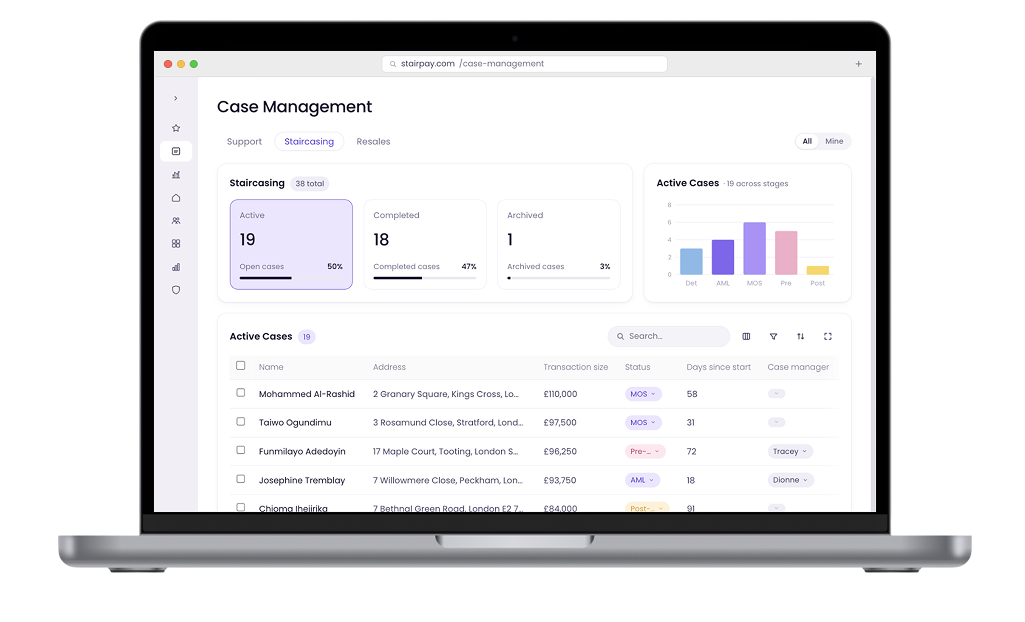
End-to-end case management
Instruction → RICS valuation → solicitor → completion. Every party sees what they need on one record, every milestone has an SLA timer, and Stairpay chases the right party automatically when a timer slips.
- 1
Instruction lands
Case opens with milestones pre-populated for the staircasing type (further share, final 100%, lease extension alongside).
- 2
Valuation triggered
RICS valuer instructed from inside the case; valuation report attaches automatically when complete.
- 3
Solicitors and broker join
Role-scoped access for the resident's solicitor, the Housing Association's solicitor, and the broker — no new accounts, no portal sprawl.
- 4
SLAs run in the background
Each milestone has a configurable SLA timer ("valuation to memo of sale: 10 working days"), and Stairpay chases the right party automatically when timers slip.
- 5
Completion settles cleanly
Settlement figures, equity changes, and lease updates write back to the resident record, so finance and compliance see the new state without a handover note.
Pipeline and revenue MI
Cases by stage, days-in-stage, conversion rates, expected revenue, and leakage analysis — forecast staircasing revenue from real cases at real stages, and find the bottleneck before it costs the year.
Forecast staircasing revenue with real numbers
Expected revenue rolled up from real cases at real stages — not last year's average multiplied by ambition. Finance models on actuals, not assumptions.
Find the leak before it costs the year
Leakage analysis surfaces where cases stall — instruction to valuation, valuation to mortgage offer, offer to completion — so you fix the bottleneck rather than guessing at it.


The numbers behind aftersales.
What Stairpay delivers from day one.
Time to ROI
2months
to break even on the platform
Avg. staircasing uplift
50%
more cases completed per year
Time saved per case
4hours
of HA team work, automated away
Structured datapoints per resident
50+
captured and queryable